C4C4.1 · Big builds · 7:40 · 23 Oct 2026Premieres Fri 23 Oct · 7:15 PM IST
How India's Bullet Train Tunnels Under the Sea in Mumbai
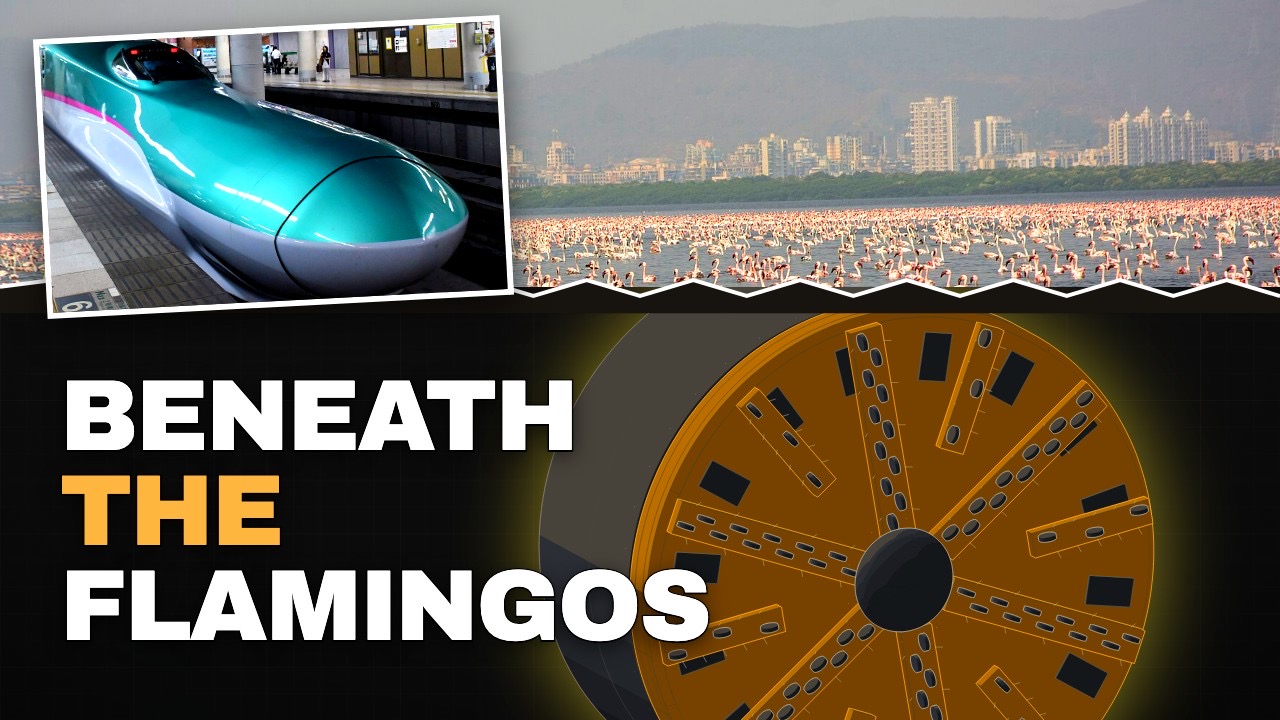
India's bullet train ends in a 21 km tunnel under Mumbai, with about 7 km beneath Thane Creek. We draw the 13.6 m tunnel boring machine, the slurry that holds back the water and the concrete rings it builds behind itself. Then we check which part is really under the sea, and how far along it is.
 Play · 7:40
Chapters
- 0:00A railway under the seaPlay
- 0:50Why not a bridge?Play
- 1:02The section: shafts and depthsPlay
- 1:38Drill and blast, or borePlay
- 2:06Inside the tunnel boring machinePlay
- 2:52The real enemy: water pressurePlay
- 3:19How the Mixshield holds the facePlay
- 3:41Rings, seals and sensorsPlay
- 4:30The honest part: which bit is under the sea?Play
- 4:54What "undersea" meansPlay
- 5:09The machines were latePlay
- 5:21The pace mathsPlay
- 5:44The moneyPlay
- 6:21The trainsPlay
- 6:47When will it open? Your guessPlay
In short
The last 21 km go underground. The 508 km Mumbai–Ahmedabad line runs almost entirely on viaducts, except at the Mumbai end: a single tunnel, both tracks side by side, from a station 32.5 m below Bandra-Kurla Complex to Shilphata. About 7 km of it is under Thane Creek, which the builder, NHSRCL, calls India's first undersea rail tunnel.
Two machines, one ring at a time. About 16 km is bored by two Mixshield tunnel boring machines, each about 96 m long with a 13.6 m cutterhead. The other 5 km, under Parsik hill, was dug by drill and blast and broke through in September 2025. Behind the cutterhead, the machine builds the tunnel from concrete rings of nine segments and a key, each joint sealed twice.
The enemy is water. Under a creek, groundwater pushes on the face being cut. A Mixshield fills the chamber behind its cutterhead with pressurised bentonite slurry that pushes back, and the same slurry carries the cut ground out to a cleaning plant on the surface. In our example at 40 m deep, the water pushes on the face with about 6,000 tonnes.
The undersea part has only just started. The finished 5 km are on the mainland. The creek crossing is the second machine's 10 km drive from Sawli to Vikhroli, which began on 18 July 2026. At the roughly 300 m a month officials have quoted, it finishes around early 2029; the minister has said BKC opens in 2029. The estimate has risen to about ₹1.98 lakh crore, and the first section, Surat–Vapi, is due in 2027 with an Indian-built train.
Sources & credits
- NHSRCL · Contract for the 21 km tunnel, including India's first undersea tunnel (Jun 2023)
- NHSRCL · 5 km tunnel completed between Ghansoli and Shilphata (20 Sep 2025)
- NHSRCL · TBM assembly begins at Vikhroli: specs and segments (9 Apr 2026)
- NHSRCL · First TBM starts excavation at Vikhroli (5 Jul 2026)
- NHSRCL · Second TBM starts the undersea tunnel (18 Jul 2026)
- PIB · Mumbai–Ahmedabad High-Speed Rail backgrounder (12 Jun 2026)
- JICA · ODA loan for the Mumbai–Ahmedabad High-Speed Rail (Dec 2023)
- Akashvani News · First section by 2027, Thane 2028, BKC after (20 Sep 2025)
- Indian Express · Revised cost near ₹1.98 lakh crore (2 Jan 2026)
- Indian Express · Indian trains first, E10 Shinkansen in the early 2030s (17 Jul 2026)
- Economic Times · Tunnel boring machines held at a Chinese port (24 Jun 2025)
- Hindustan Times · Officials' finish dates for the tunnel drives (6 Jul 2026)
The maker (Herrenknecht) and the months at a Chinese port come from news and trade press; “under 2 km beneath the open channel” is from 2017–18 planning reports and unconfirmed; the 6,000-tonne figure is our calculation for an example depth of 40 m. The machine drawings are a generic Mixshield layout, and machine photos are from other tunnels. Not affiliated with NHSRCL, Indian Railways, Afcons or Herrenknecht. Photos via Wikimedia Commons: Mumbai and Thane Creek by Dr. Raju Kasambe (CC BY-SA 4.0), Betame (CC0), Gaurav Vaidya (CC BY 3.0), N. Vivekananthamoorthy (CC BY 4.0), This Now (CC BY 4.0) and Mohammedhabib (CC BY-SA 4.0); tunnelling by Pauli-Pirat (CC BY-SA 4.0), Erik Lundin (CC BY-SA 3.0), Louise Andersson / Näringsdepartementet (CC BY 2.0), MTA (CC BY 2.0), John Cowper (CC BY 2.0), Peterbuild (CC BY-SA 4.0), JMK (CC BY-SA 3.0), U.S. Navy (public domain) and Martin Chovanec (CC BY-SA 4.0); E5 Shinkansen by Gzzz (CC BY-SA 4.0), E7 Shinkansen by Asanagi (CC0), container ship by Iglheaz (public domain). Narration voice generated with Kokoro TTS.
Transcript
Read the full narration
0:00 · A railway under the sea
India is digging a railway under the sea. The hardest part has only just begun.
This is the Mumbai to Ahmedabad bullet train. Five hundred and eight kilometres, built with Japanese Shinkansen technology, almost all of it on bridges. Except the last twenty-one kilometres. Those run underground. From a station deep below Bandra-Kurla Complex, under the city, the Mithi River and Thane Creek, to Shilphata.
About seven of those kilometres are under the creek. The builder, the National High Speed Rail Corporation, calls it India's first undersea rail tunnel.
How do you dig a hole that big, under a city and under the sea? Let's draw it.
0:50 · Why not a bridge?
Why not a bridge? At BKC, there's no room. And the creek is a protected flamingo sanctuary, lined with mangroves. A tunnel passes underneath without touching them.
1:02 · The section: shafts and depths
Here's the section. One: BKC station, thirty-two and a half metres down. Two: a shaft at Vikhroli, fifty-six metres deep. A twenty-storey building, upside down. Three: a shaft at Sawli, near Ghansoli, thirty-nine metres. Four: the portal at Shilphata.
Most of the tunnel runs twenty-five to fifty-seven metres down. Under the Parsik hill, it's a hundred and fourteen.
And it's one tube. Both tracks side by side, in a single bore thirteen point one metres across.
1:38 · Drill and blast, or bore
There are two ways to dig it.
The eastern five kilometres, from Ghansoli under the Parsik hill, used the New Austrian Tunnelling Method. Drill, blast, spray concrete on the fresh rock, measure how it moves, adjust. It broke through in September twenty twenty-five.
The other sixteen kilometres run under buildings, a river and the creek. No blasting there. So, two tunnel boring machines.
2:06 · Inside the tunnel boring machine
Let's take one apart.
It's about ninety-six metres long and weighs over three thousand tonnes. Both were made by the German company Herrenknecht.
One: the cutterhead. Thirteen point six metres across, as tall as a four-storey building. It turns at up to four revolutions a minute. Eighty-four steel discs crack the ground. A hundred and twenty-four scrapers clear it.
Two: a chamber of pressurised slurry.
Three: the shield, a steel tube that holds the ground up.
Four: the erector, an arm that builds the tunnel wall.
Five: four gantries trailing behind. Pumps, power, grout, and a refuge chamber for the crew.
2:52 · The real enemy: water pressure
Under a creek, the enemy isn't rock. It's water.
Take forty metres down, as an example. Water pushes on every square metre of the face with about forty tonnes. The face is about a hundred and forty-five square metres. That's nearly six thousand tonnes. Roughly twice the weight of the machine.
If nothing pushes back, the face collapses and the water pours in.
3:19 · How the Mixshield holds the face
So these are Mixshield machines. The chamber behind the cutterhead holds bentonite slurry, a heavy clay-and-water mix, under pressure. It pushes back, and the face holds.
The slurry also carries the cut rock out through pipes. A crusher breaks big stones first. On the surface, a plant cleans the slurry and sends it back down.
3:41 · Rings, seals and sensors
Behind the cutting, the machine builds the tunnel. Every two metres, a ring. Nine curved concrete segments, then one key that locks them. Each half a metre thick. A full ring weighs about a hundred tonnes.
Hydraulic rams push the machine forward off the last ring. And it can keep cutting while the next ring goes in.
Sixteen kilometres means seven thousand seven hundred rings. Seventy-seven thousand segments, all cast at Mahape.
Every joint is sealed twice. Two rubber gaskets, plus a seal that swells when wet.
On the surface, sensors watch whether buildings move. Inside, they track methane, oxygen, carbon monoxide and carbon dioxide.
4:30 · The honest part: which bit is under the sea?
Now, the honest part.
One: which part is really under the sea? The five kilometres already finished run on the mainland, under the hill. The creek crossing is the second machine's ten-kilometre drive, from Sawli to Vikhroli. It only started on the eighteenth of July, twenty twenty-six. Since then, the builder hasn't said how far either machine has gone.
4:54 · What "undersea" means
Two: what "undersea" means. Thane Creek is a tidal zone. Open water in the middle, mudflats and mangroves on each side. Early planning reports said less than two kilometres runs under the open channel.
5:09 · The machines were late
Three: the machines were late. They were built at Herrenknecht's factory in China. Reports say they sat at a Chinese port for months, until India raised it through diplomatic channels.
5:21 · The pace maths
Four: the pace. Officials have told reporters each machine should do about three hundred metres a month. At that rate, the first machine reaches BKC in early twenty twenty-eight. The undersea drive finishes in early twenty twenty-nine. Officials have also quoted March twenty twenty-eight. That needs close to five hundred metres a month.
5:44 · The money
Five: the money. The project was estimated at one lakh, eight thousand crore rupees. About twelve billion dollars. In January, the Railway Board chairman put the revised figure near one lakh, ninety-eight thousand crore. About twenty-two billion. The ministry blames taxes, land, inflation, and costs the first estimate left out. Japan's aid agency, JICA, lends most of the original amount, at zero point one percent over fifty years. Reports say the extra will come from India's own budget.
6:21 · The trains
Six: the trains. The line is designed for three hundred and fifty kilometres an hour, to run at three hundred and twenty. But Japan's next Shinkansen, the E10, isn't expected until the early twenty-thirties. So the first section, Surat to Vapi, is due in August twenty twenty-seven. With an Indian-built train, designed for two hundred and eighty. Mumbai opens last.
6:47 · When will it open? Your guess
In twenty twenty-five, the railway minister said Thane would come in twenty twenty-eight, and BKC the year after. In August, reports said the full corridor could slip to twenty thirty.
What's certain is the engineering. Two machines, each pushing a four-storey cutting wheel through rock, mud and seawater. One ring at a time. Seven thousand seven hundred times.
So here's our question. The minister said twenty twenty-nine for BKC. The machines' own pace says that's tight. What's your guess? Tell us in the comments.