C1C1.1 · Cars & vehicles · 7:56 · 20 Oct 2026Premieres today · 7:15 PM IST
Tesla's New Roadster Can Fly?! The Engineering Explained
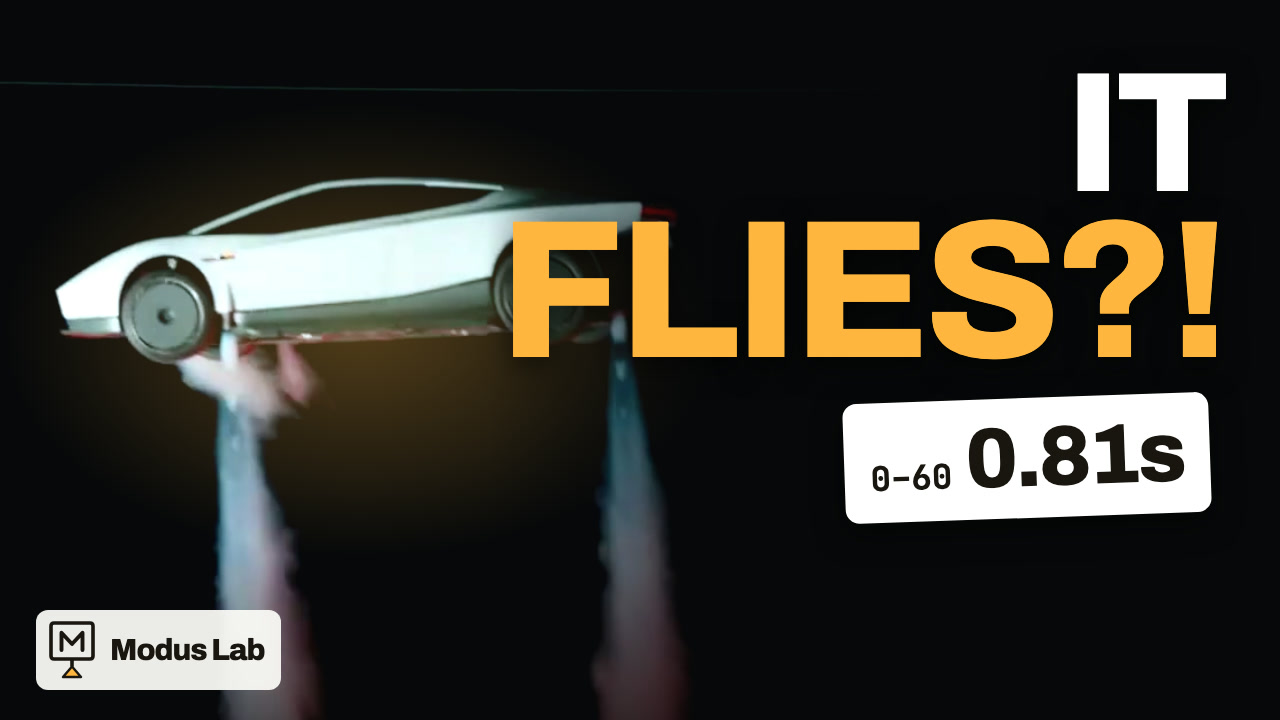
It drove up a wall, hung upside down, flipped through the air and flew. Then it ran 0 to 60 mph in 0.81 seconds. Here's how the new Tesla Roadster works, and which parts are real engineering versus a show.
 Play · 7:56
Chapters
- 0:00The car that breaks physicsPlay
- 0:2120 years in the makingPlay
- 1:16Four Roadsters in onePlay
- 1:57Rear-wheel drive & the batteryPlay
- 3:05Fans, downforce & active aeroPlay
- 4:30The SpaceX cold-gas thrustersPlay
- 5:45The party tricksPlay
- 6:24Inside the cockpitPlay
- 6:44Reality checkPlay
- 7:25Final thoughtsPlay
In short
There are four Roadsters, not one. Each version adds hardware on top of the last: the base car, Performance with a fan system, Thrust with a nitrogen tank and rear thrusters, and an invitation-only Rocket with ten thrusters and one seat.
The fan system is the real engineering story. Tyres stop gripping at about 1.25 g. Four fans pull air from under a sealed floor so the atmosphere presses the car down at more than 2 g, even when it isn't moving. Wings can't do that below about 50 mph. At speed, the skirts lift and the active aero takes over.
The thrusters are a SpaceX idea. A 200-litre carbon-wrapped tank holds nitrogen at 10,000 psi. Released through four nozzles it gives over 80 kN, about one fighter-jet engine without afterburner, but only for a few seconds per fill.
Some of it is still a promise. The flying demos were autonomous and scripted, the Rocket isn't road-legal, refills take hours, and the last Roadster was promised for 2020. The video ends with an honest reality check.
Sources & credits
Specs come from Tesla's reveal and interviews with Tesla's engineering and design leads. Figures Tesla hasn't confirmed, such as battery size, final price and the 330 mph target, are shown as targets or reports.
- Tesla · Roadster Event
- Hagerty · The flying Tesla Roadster explained by the man who engineered it
- MotorTrend · Full walkaround with the Roadster's chief designer
- MotorTrend · Inside Tesla's 2028 Roadster
- Top Gear · New Tesla Roadster
- Marques Brownlee · The new Tesla Roadster: my honest reaction
Short clips from these videos appear in ours for commentary and review, credited on screen. Photos via Wikimedia Commons: 2008 Tesla Roadster by TaurusEmerald (CC BY-SA 4.0), Chaparral 2J by Craig Howell (CC BY 2.0), McMurtry Spéirling by Calreyn88 (CC BY-SA 4.0). Narration voice generated with ElevenLabs.
Transcript
Read the full narration
0:00 · The car that breaks physics
Zero to sixty miles an hour. In zero point eight one seconds.
That was a live run, in front of a crowd, at a rocket test site in Texas. And it wasn't even the strangest thing this car did that night.
It drove up a wall. It hung upside down. And then it flew.
0:21 · 20 years in the making
To understand this car, go back to two thousand eight. Tesla's first product was a Roadster: a Lotus chassis, a lithium-ion battery, and a point to prove. Electric cars didn't have to be slow, or dull.
In twenty seventeen, Tesla promised a sequel: one point nine seconds to sixty, six hundred and twenty miles of range, on sale in twenty twenty. Then it disappeared. Much of its hardware quietly became the Model S Plaid. And one Roadster famously went to space, with a mannequin called Starman at the wheel.
Nine years later, on October fifteenth, twenty twenty-six, the Roadster finally came back. It was unveiled at SpaceX's test site in McGregor, Texas, built jointly by Tesla and SpaceX engineers.
Tesla calls it two things at once: the last great driver's car, and the first great flying car.
1:16 · Four Roadsters in one
Here's what got lost in the spectacle: there isn't one new Roadster. There are four, and each one stacks hardware on top of the last.
The base Roadster is a rear-drive, two-seat electric sports car.
Performance adds a fan system that sucks the car onto the road: under one point six seconds to sixty.
Thrust adds a SpaceX-built tank of compressed nitrogen that fires out the back: under zero point nine seconds.
And Rocket swaps the passenger seat for a second, bigger tank and six extra thrusters: under zero point five nine seconds, invitation only, and not approved for public roads.
Production is planned for twenty twenty-eight, at Giga Texas.
1:57 · Rear-wheel drive & the battery
Start with the part every version shares. And the first surprise? It's rear-wheel drive only.
Tesla has built all-wheel-drive monsters for a decade. This time, it chose two motors, both on the rear axle, for feel. There's no differential: each motor drives one wheel through its own planetary gearset, so the car can push each rear tyre independently.
Together they make more than a megawatt, about thirteen hundred and forty horsepower. Each motor is smaller than a Plaid motor, yet the pair out-muscles all three of the Plaid's, combined.
Feeding them is a battery built just for this car. It uses Tesla's forty-six eighty cells with a high-power chemistry, aluminium cans instead of steel, and coolant on both sides of every row of cells. The top cover is titanium.
The goal is power that doesn't fade: twenty-five to thirty minutes of flat-out track driving, then roughly ten minutes on a five-hundred-kilowatt charger to get back out.
Range is just over three hundred miles, half the old promise. That's deliberate, because the target weight is under seventeen hundred kilograms. For a car this powerful, that's light.
3:05 · Fans, downforce & active aero
Here's the problem with a megawatt: tyres. Even the best rubber gives you about one and a quarter g of grip. Push harder, and you just spin.
Wings help, but only once you're moving fast. Below about fifty miles an hour, they do almost nothing.
So Tesla built a vacuum cleaner. Four fans in the rear diffuser are adapted from the car's own heat-pump compressor motor. Skirts drop down around a floor area about the size of the battery pack, and the fans pull the air out from underneath. The atmosphere does the rest, pressing the car into the road with more than two g of force, even when it's standing still.
Two g is the magic number: one g cancels gravity, and the second holds you on. On paper, that's enough to drive upside down.
At high speed, the system changes role. The front and rear skirts lift and air rushes under the floor, while the active aero takes over. Wings hidden behind the nose pivot up to eighty degrees, and panels you'd swear were fixed pop out as barge boards. At the back, a two-tier wing switches between airbrake and low drag. It's moved by actuators borrowed from Tesla's Optimus humanoid robot: the ankle joints, with a brake added.
Fan cars aren't new. Chaparral raced one in nineteen seventy, and the McMurtry Spéirling has already driven upside down. But nobody has put one in a production road car.
4:30 · The SpaceX cold-gas thrusters
Now, the part nobody else could build.
On the Thrust version, the trunk is filled by a carbon-overwrapped pressure vessel: the same kind of tank SpaceX flies. It's two hundred litres of nitrogen, at ten thousand P-S-I, sitting right behind your head.
Nitrogen, because Tesla didn't want to burn fuel. These are cold-gas thrusters, the same principle satellites use to nudge themselves around in orbit. Open the valve, and the gas leaves four nozzles faster than sound. You can see the shock diamonds. That's over eighty kilonewtons of thrust, about the same as a fighter-jet engine without afterburner.
The left and right sides are controlled separately. If one side flowed even ten percent more than the other, the car would spin, so the computer balances them constantly.
The catch? It's a single shot, of roughly three to five seconds. Then the tank is empty, and refilling takes hours today. Tesla's target is about thirty minutes.
The Rocket version goes further. It adds a four-hundred-litre tank where the passenger would sit, for six hundred litres in total. It also adds six more nozzles: four pointing at the ground behind the wheels, and two at the nose for steering. That's not for going faster. It's for leaving the ground.
5:45 · The party tricks
Which brings us to the show.
First, the car drove up a curved wall until it was hanging completely upside down, held there by nothing but its fans.
Then it launched off the top, rolled through the air in what Tesla called a kickflip, and landed on its wheels.
Then came free flight: a Roadster hovering on columns of cold nitrogen, with a Starman dummy riding along.
And to finish, a live sprint: zero to sixty, in zero point eight one seconds.
And Tesla says it isn't done. On stage, Musk floated a rocket-car jump in the spirit of Evel Knievel's Snake River Canyon attempt, and set the team a target of half the speed of sound.
6:24 · Inside the cockpit
Inside, everything is about weight and focus. The seats are moulded into the chassis, so the pedals move to fit you instead.
There's a steer-by-wire yoke that never needs more than a half turn either way. Headlights pop down, not up. The roof panels lift out. And the glass carries a gold tint, borrowed from an astronaut's visor.
6:44 · Reality check
Now, the honest part.
The flying demos were autonomous and pre-scripted. The Rocket version is invitation only, and not road-legal. Thrust can't be fired on public roads. And nobody has yet explained how a ten-thousand-P-S-I tank next to the driver behaves in a serious crash.
There's also history. The last Roadster was promised for twenty twenty, and never arrived. Reservations reportedly start at fifty thousand dollars for Performance, and two hundred and fifty thousand for Thrust, and the final price hasn't been announced.
But the core idea, fans that give you grip tyres can't, is real engineering, with a real benefit on track.
7:25 · Final thoughts
Twenty years ago, the first Roadster proved electric cars could be fun. This one is trying to prove something stranger: that a car can still surprise us.
Is it the last great driver's car, or the most expensive party trick ever built? Let me know which version you'd pick.